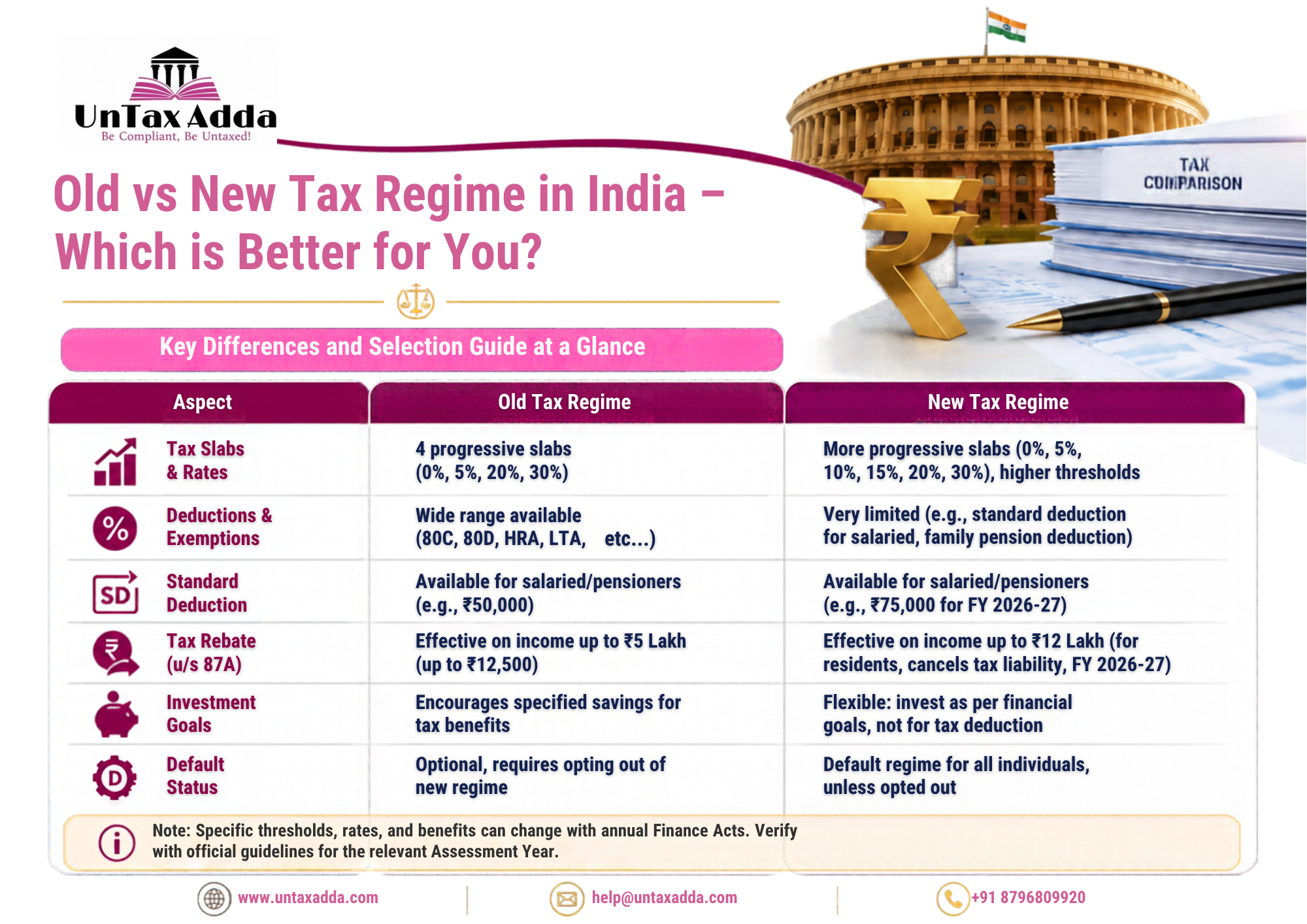
Choosing the right tax regime is one of the most important annual financial decisions for Indian taxpayers. Ever since the introduction and subsequent updates to the New Tax Regime under Section 115BAC, a common debate persists every tax-filing season: Old vs. New Tax Regime — which one actually saves more tax?
With the New Tax Regime serving as the default tax option for taxpayers, understanding how both systems function is essential before filing your Income Tax Return (ITR).
This comprehensive guide by Untax Adda breaks down the latest tax slabs, compares key deductions, explains the "Break-Even Point," and provides realistic numerical examples to help you make an informed decision.
1. Overview of the Two Tax Regimes
|
Feature |
Old Tax Regime |
New Tax Regime (Default) |
|
Primary Philosophy |
High tax rates offset by aggressive tax-saving investments & exemptions. |
Simplified tax structure with lower tax slab rates and minimal paperwork. |
|
Standard Deduction |
₹50,000 for salaried employees and pensioners. |
₹75,000 for salaried employees and pensioners. |
|
Tax Slabs |
Higher rates (5%, 20%, 30%) with steep jumps. |
Lower, progressive tax rates across smaller income brackets. |
|
Tax-Free Income Limit (via Section 87A Rebate) |
Taxable income up to ₹5 Lakhs pays ₹0 tax. |
Taxable income up to ₹12 Lakhs pays ₹0 tax (Effective ₹12.75 Lakhs for salaried with Standard Deduction). |
|
Deductions & Exemptions |
Allows 70+ exemptions (80C, 80D, HRA, Home Loan Interest, etc.). |
Most popular deductions disallowed (except Section 80CCD(2) employer NPS). |
2. Tax Slab Comparison
New Tax Regime Slabs (FY 2025–26 / FY 2026–27)
The New Tax Regime provides wider income slabs to distribute the tax burden evenly:
|
Income Slab |
Tax Rate |
|
Up to ₹4,00,000 |
NIL |
|
₹4,00,001 to ₹8,00,000 |
5% |
|
₹8,00,001 to ₹12,00,000 |
10% |
|
₹12,00,001 to ₹16,00,000 |
15% |
|
₹16,00,001 to ₹20,00,000 |
20% |
|
₹20,00,001 to ₹24,00,000 |
25% |
|
Above ₹24,00,000 |
30% |
Key Advantage: Resident individuals earning up to ₹12 Lakhs receive a full tax rebate under Section 87A (up to ₹60,000 rebate). Combined with the ₹75,000 Standard Deduction, a salaried professional with a gross income of ₹12.75 Lakhs pays zero income tax under the New Tax Regime.
Old Tax Regime Slabs (Individuals under 60 years)
The Old Tax Regime maintains higher baseline tax rates:
|
Income Slab |
Tax Rate |
|
Up to ₹2,50,000 |
NIL |
|
₹2,50,001 to ₹5,00,000 |
5% |
|
₹5,00,001 to ₹10,00,000 |
20% |
|
Above ₹10,00,000 |
30% |
(Note: Senior citizens aged 60–79 have a basic exemption limit of ₹3 Lakhs, and Super Senior citizens aged 80+ have an exemption limit of ₹5 Lakhs under the Old Regime).
3. Deductions & Exemptions: What Do You Give Up?
To benefit from the lower rates of the New Tax Regime, you must forego most deductions available under the Old Tax Regime.
Popular Deductions Allowed ONLY in the Old Regime:
- Section 80C: Up to ₹1.5 Lakhs (PPF, EPF, ELSS, Life Insurance, School Tuition Fees, Home Loan Principal).
- Section 80D: Up to ₹25,000 (₹50,000 for senior citizens) for Health Insurance premiums.
- Section 24(b): Up to ₹2 Lakhs on Home Loan Interest for self-occupied properties.
- House Rent Allowance (HRA): Tax exemption on rent paid (Section 10(13A)).
- Leave Travel Allowance (LTA) & Special Allowances: Travel reimbursements and child education allowances.
- Section 80E: Interest paid on higher education loans.
- Section 80TTA/80TTB: Deduction on savings account interest.
Deductions Retained in BOTH Regimes:
a) Standard Deduction on Salary/Pension: ₹75,000 in New Regime vs. ₹50,000 in Old Regime.
b) Employer Contribution to NPS (Section 80CCD(2)): Up to 14% of basic salary for government/private employees.
c) Transport Allowance: Exemption for specially-abled employees.
4. Head-to-Head Tax Savings Example
Let's compare two salaried taxpayers with different investment profiles under both regimes.
Scenario A: Salaried Employee Earning ₹12.5 Lakhs Gross Salary
a. Salary: ₹12,50,000
b. Deductions claimed under Old Regime:
1) Standard Deduction: ₹50,000
2) Section 80C: ₹1,50,000
3) Section 80D: ₹25,000
4) HRA Exemption: ₹1,00,000
5) Total Deductions = ₹3,25,000
|
Calculation Step |
Old Tax Regime |
New Tax Regime |
|
Gross Salary |
₹12,50,000 |
₹12,50,000 |
|
Standard Deduction |
-₹50,000 |
-₹75,000 |
|
Other Exemptions (HRA, 80C, 80D) |
-₹2,75,000 |
₹0 (Not allowed) |
|
Net Taxable Income |
₹9,25,000 |
₹11,75,000 |
|
Base Tax Payable |
₹97,500 |
₹57,500 |
|
Section 87A Rebate |
₹0 |
-₹57,500 (Rebate applicable up to ₹12L) |
|
Health & Education Cess (4%) |
₹3,900 |
₹0 |
|
Total Tax Payable |
₹1,01,400 |
₹0 |
Result: The taxpayer saves ₹1,01,400 by choosing the New Tax Regime.
Scenario B: High-Deduction Salaried Employee Earning ₹18 Lakhs Gross Salary
a. Salary: ₹18,00,000
b. Deductions claimed under Old Regime:
1) Standard Deduction: ₹50,000
2) Section 80C: ₹1,50,000
3) Section 80D: ₹50,000 (Self + Senior Citizen Parents)
4) Section 24(b) Home Loan Interest: ₹2,00,000
5) HRA Exemption: ₹1,50,000
6) Total Deductions = ₹6,00,000
|
Calculation Step |
Old Tax Regime |
New Tax Regime |
|
Gross Salary |
₹18,00,000 |
₹18,00,000 |
|
Standard Deduction |
-₹50,000 |
-₹75,000 |
|
Other Exemptions (HRA, 80C, 80D, Home Loan) |
-₹5,50,000 |
₹0 |
|
Net Taxable Income |
₹12,00,000 |
₹17,25,000 |
|
Base Tax Payable |
₹1,72,500 |
₹1,45,000 |
|
Health & Education Cess (4%) |
₹6,900 |
₹5,800 |
|
Total Tax Payable |
₹1,79,400 |
₹1,50,800 |
Result: Even with ₹6,00,000 in aggregate deductions, the lower slab structure of the New Tax Regime saves ₹28,600.
5. The Break-Even Point: How Much Deduction Do You Need?
To make the Old Tax Regime beneficial over the New Tax Regime, your total eligible tax deductions (HRA + 80C + 80D + Home Loan Interest, etc.) must cross a specific threshold, known as the Break-Even Point.
Average Break-Even Thresholds by Income Level:
1. Income up to ₹12.75 Lakhs: New Tax Regime is almost unbeatable (0 Tax liability)
2. Income ₹15 Lakhs: Requires ~₹4.25 Lakhs+ in deductions for Old Regime to win
3. Income ₹20 Lakhs: Requires ~₹4.75 Lakhs+ in deductions for Old Regime to win
4. Income ₹25 Lakhs+: Requires ~₹5.00 Lakhs+ in deductions for Old Regime to win
If your total deductions fall below these thresholds, stick with the New Tax Regime.
6. How to Choose: Decision Checklist for Untax Adda Readers
Choose the NEW Tax Regime if:
a) Your gross income is up to ₹12.75 Lakhs (you will pay zero tax).
b) You do not pay high house rent or a home loan EMI.
c) You prefer immediate liquidity over locking cash into 3 to 5-year tax-saving schemes (ELSS, PPF, FDs).
d) You want hassle-free ITR filing without submitting proofs, receipts, or rent agreements.
Choose the OLD Tax Regime if:
a) You carry significant financial commitments that generate big deductions (Home Loan Interest + HRA + Section 80C + Section 80D).
b) Your total eligible deductions easily surpass ₹4.25 Lakhs to ₹5 Lakhs per year.
c) You rely on tax deductions to maintain a disciplined, mandatory long-term investment strategy.
Can You Switch Between Regimes Every Year?
a) Salaried Individuals & Pensioners: Yes! You can choose between the Old and New Tax Regimes every year at the time of filing your ITR (Form ITR-1 or ITR-2).
b) Business Owners & Freelancers (Income from Business/Profession): No. Business taxpayers can opt out of the New Regime to choose the Old Regime only once in a lifetime by filing Form 10-IEA. Once they switch back to the New Regime, they cannot re-enter the Old Regime in subsequent years.
Need expert help determining your exact break-even point or optimizing your salary structure? Connect with our team of tax advisors at Untax Adda for personalized tax filing support!