Get Your GST Registration Quickly & Hassle-Free
Starting a new business in India? GST Registration is one of the most important legal compliances for businesses. Whether you are a Proprietorship, Partnership Firm, LLP, Private Limited Company, Freelancer, E-commerce Seller, or Service Provider, obtaining a GST Registration is essential to operate legally and claim Input Tax Credit (ITC).
At Untax Adda, we provide 100% online GST Registration services across India with expert support from qualified professionals.
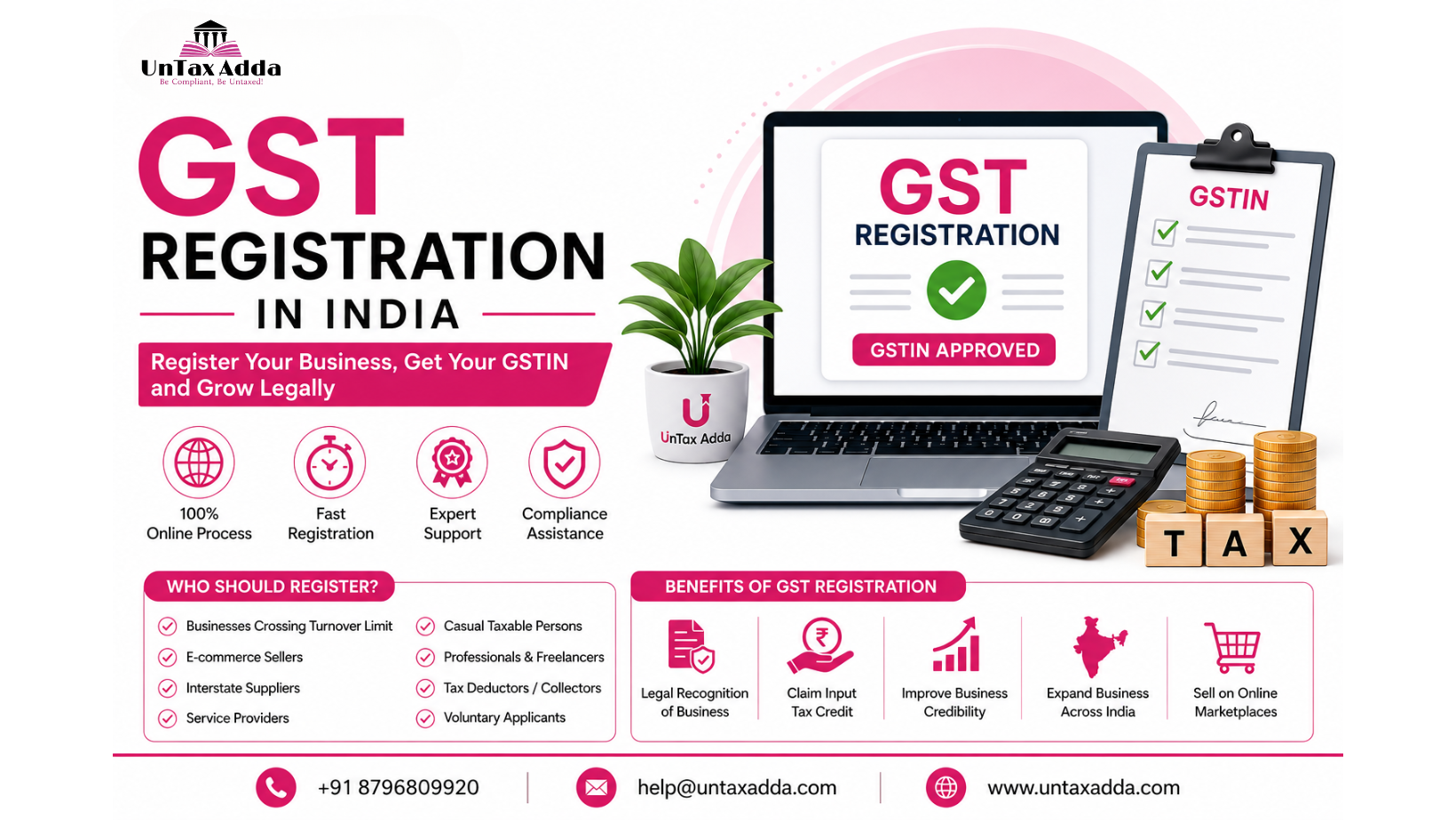
Apply Now and get your GSTIN without any hassle!
What is GST Registration?
GST (Goods and Services Tax) Registration is the process through which a business obtains a unique Goods and Services Tax Identification Number (GSTIN) from the Government of India.
After registration, the business becomes a registered taxpayer and can:
a) Collect GST from customers
b) Claim Input Tax Credit (ITC)
c) File GST Returns
d) Conduct interstate business legally
e) Sell on online marketplaces such as Amazon, Flipkart, Meesho, etc.
GST registration is completely online through the official GST portal.
Who Should Register Under GST?
GST Registration is mandatory for:
a) Businesses crossing the prescribed turnover limit.
b) Interstate suppliers of taxable goods.
c) E-commerce sellers.
d) Casual taxable persons.
e) Non-resident taxable persons.
f) Persons liable under Reverse Charge Mechanism (RCM).
g) Input Service Distributors (ISD).
h) Tax Deductors (TDS) and Tax Collectors (TCS).
i) Agents supplying goods or services on behalf of others.
j) Voluntary applicants who wish to avail Input Tax Credit.
GST Registration Threshold Limit
|
Business Type |
Registration Limit |
|
Supply of Goods |
Rs. 40 Lakhs (in most States) |
|
Supply of Services |
Rs. 20 Lakhs Rs. 10 Lakh, Special Category States |
Note: Certain businesses must obtain GST Registration irrespective of turnover as specified under the GST law.
Step-by-Step GST Registration Process
Step 1 – Document Collection
The applicant submits all required documents including PAN, Aadhaar, address proof, bank details, and business information.
Step 2 – Verification of Documents
Our GST experts verify all documents to avoid rejection or issuance of notices.
Step 3 – Preparation of Application
Form GST REG-01 is prepared with:
a) Business Details
b) Promoter Details
c) Principal Place of Business
d) Additional Places of Business
e) Goods & Services
f) Bank Details
g) Authorized Signatory Details
Step 4 – Aadhaar Authentication
The applicant completes Aadhaar Authentication through OTP or biometric verification, wherever applicable. Aadhaar authentication generally speeds up the registration process.
Step 5 – Application Submission
The application is digitally verified using:
a) Electronic Verification Code (EVC), or
b) Digital Signature Certificate (DSC), where required.
Step 6 – ARN Generation
After successful submission, an Application Reference Number (ARN) is generated for tracking the application.
Step 7 – Department Verification
The GST Officer examines the application.
If additional clarification is required, a notice in Form GST REG-03 is issued, and the applicant must respond in Form GST REG-04 within the prescribed time.
Step 8 – GST Certificate Issued
Upon approval, the applicant receives:
a) GSTIN
b) GST Registration Certificate
c) Login credentials for the GST Portal
Time Required for GST Registration
Normally:
a) 3–7 working days for Aadhaar-authenticated and low-risk applications.
b) In case of Registration under Rule 14A of the CGST Rule, it is automated and the applicant gets the approval on the same day.
c) Longer where clarification or physical verification is required.
Benefits of GST Registration
✔ Legally collect GST
✔ Claim Input Tax Credit (ITC)
✔ Improve business credibility
✔ Expand business across India
✔ Sell on Amazon, Flipkart, Meesho, Jiomart, etc.
✔ Participate in Government Tenders
✔ Obtain business loans more easily
✔ Build trust among customers
Common Reasons for GST Registration Rejection
a) Incorrect PAN details
b) Mismatch in Aadhaar information
c) Invalid rent agreement
d) Poor quality documents
e) Wrong HSN/SAC selection
f) Incomplete address proof
g) Improper business activity description
h) Incorrect jurisdiction selection
What Happens After GST Registration?
After receiving GSTIN, a business should:
a) Display GSTIN at the principal place of business.
b) Issue GST-compliant tax invoices.
c) Update bank account details (if not already provided).
d) File GST returns within due dates, even if there is no business activity (where applicable).
e) Maintain books of accounts and records as required under GST law.
Why Choose Untax Adda?
a) Qualified Tax Professionals
b) PAN India Services
c) Fast GST Registration
d) Affordable Pricing
e) End-to-End Documentation
f) GST Notice Assistance
g) Return Filing Support
h) Expert Consultation
i) Dedicated Customer Support
j) GST Refund Support
k) GST Appeal Consultancy
Frequently Asked Questions (FAQs)
Is GST Registration free?
Yes. The Government does not charge any fee for GST Registration. However, professional fees may be charged by consultants for preparing and filing the application.
Can I apply for GST Registration online?
Yes. GST Registration is completely online through the official GST portal i.e. https://www.gst.gov.in/.
Can I voluntarily obtain GST Registration?
Yes. Even if you are not legally required to register, you may obtain voluntary GST Registration.
Is GST Registration compulsory for online sellers?
Yes. Many e-commerce sellers are required to obtain GST Registration under the GST law.
Can one person obtain multiple GST registrations?
Yes. Separate GST registrations may be required for different States or may be obtained in other situations as permitted under the GST law.
CA Abhishek Mahapatra
New Delhi