Are you planning to register under GST regime? And confused about which scheme you should register under? Don't worry! Let's learn about the composition and Regular GST Schemes.
Navigating the Goods and Services Tax (GST) landscape can feel overwhelming, especially when starting or scaling a business in India. One of the most critical decisions a business owner faces during GST registration is choosing between the Regular GST Scheme and the Composition GST Scheme.
Selecting the right GST scheme directly impacts your daily operations, tax liability, pricing strategy, bookkeeping load, and ability to sell outside your home state.
In this comprehensive guide by Untax Adda, we break down both schemes, compare their core features, highlight their pros and cons, and help you determine which option fits your business goals.
1. What is the Regular GST Scheme?
The Regular GST Scheme is the standard tax framework applicable to most businesses in India. Under this structure:
(a) You collect GST directly from your customers on every taxable sale based on prescribed slab rates (0%, 5%, 18%, or 40%).
(b) You can claim an Input Tax Credit (ITC) on taxes paid for business purchases, raw materials, and capital goods.
(c) Tax payable to the government is calculated as:
Net Tax Payable= Output GST Liability – Input Tax Credit (ITC) Availed
Key Features:
(a) No Turnover Limit: Any business, regardless of size, can enroll.
(b) Interstate Operations Allowed: You can sell goods and services across state borders and conduct export/e-commerce sales.
(c) Detailed Invoicing: Requires issuing tax invoices showing detailed tax breakdowns (CGST, SGST, IGST).
(d) Higher Compliance Load: Regular monthly or quarterly filings (GSTR-1, GSTR-3B) and annual returns (GSTR-9).
2. What is the Composition GST Scheme?
The Composition GST Scheme is an optional, simplified taxation mechanism under Section 10 of the CGST Act. Designed specifically to ease the compliance burden on small businesses and micro-enterprises, it allows eligible taxpayers to pay tax at a fixed, nominal percentage of their aggregate turnover.
Eligibility & Turnover Limits:
(a) Suppliers of Goods & Manufacturers: Annual aggregate turnover up to Rs. 1.5 Crore (Rs. 75 Lakhs for Special Category / North-Eastern states).
(b) Service Providers: Annual aggregate turnover up to Rs. 50 Lakhs.
Flat Tax Rates Under Composition Scheme:
(a) Traders & Retailers: 1% of turnover (0.5% CGST + 0.5% SGST)
(b) Manufacturers: 1% of turnover (0.5% CGST + 0.5% SGST)
(c) Restaurants (not serving alcohol): 5% of turnover (2.5% CGST + 2.5% SGST)
(d) Service Providers: 6% of turnover (3% CGST + 3% SGST)
Core Restrictions:
(a) No Tax Collection from Customers: You cannot charge GST on customer invoices; tax must be paid out of pocket or factored into profit margins.
(b) No Input Tax Credit (ITC): You cannot claim ITC on purchases.
(c) No Interstate Goods Supplies: You are limited to intra-state (within the same state) sales of goods.
(d) No E-Commerce Operators: Selling through platforms like Amazon or Flipkart is prohibited.
(e) Bill of Supply: Instead of a tax invoice, you issue a "Bill of Supply" declaring "Composition taxable person, not eligible to collect tax on supplies".
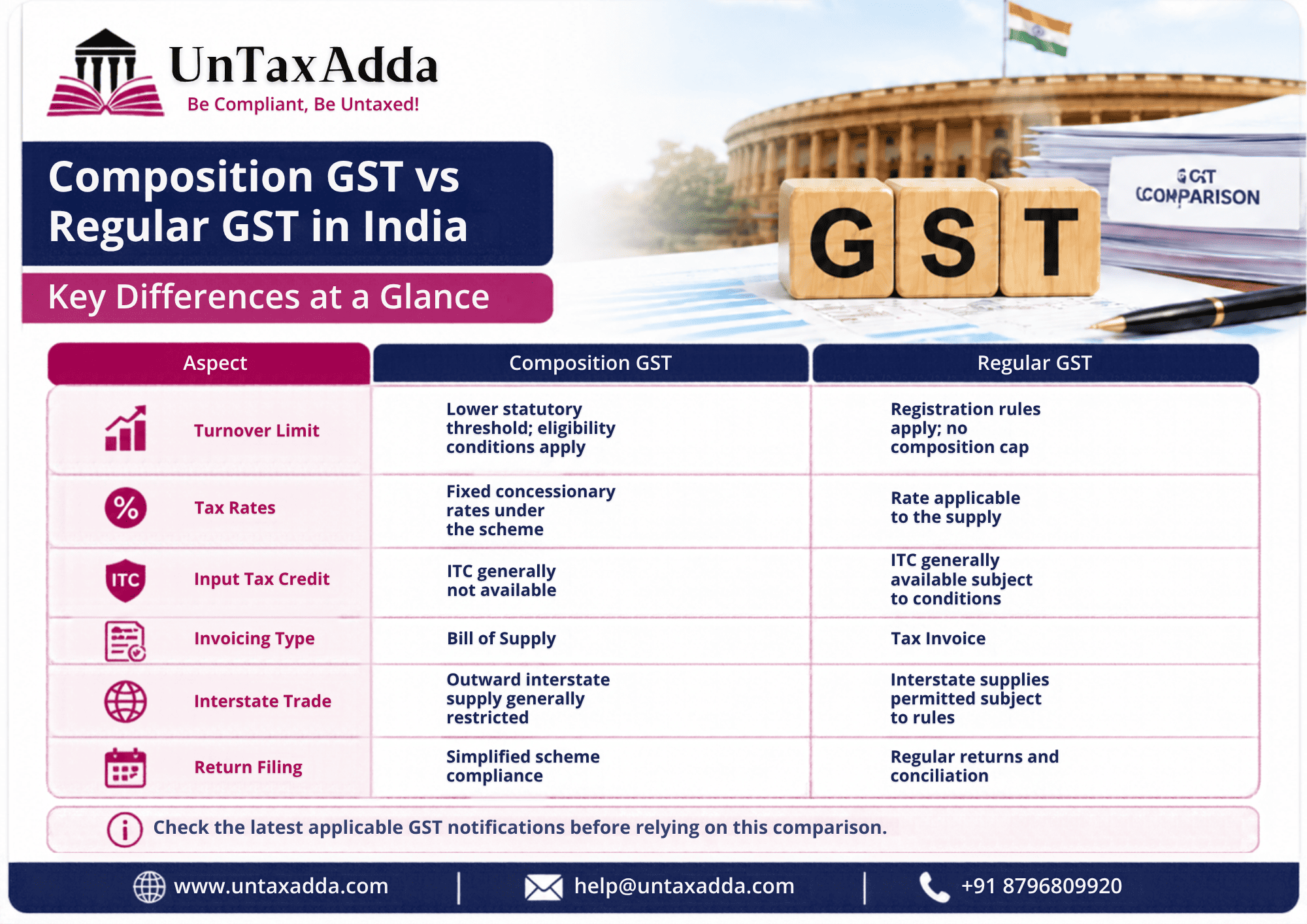
3. Head-to-Head Comparison: Composition vs. Regular GST Scheme
|
Feature |
Regular GST Scheme |
Composition GST Scheme |
|
Eligibility Target |
All businesses (Mandatory if turnover exceeds ₹20L/₹40L) |
Small taxpayers, retailers, restaurants, and small service providers |
|
Turnover Ceiling |
No maximum limit |
Up to ₹1.5 Cr for Goods (₹75L in Special States); ₹50L for Services |
|
Tax Rates |
Standard slabs (5%, 12%, 18%, 28%) |
Concessional flat rates (1%, 5%, or 6%) |
|
Input Tax Credit (ITC) |
Fully available on eligible purchases |
Strictly prohibited |
|
Tax Collection |
Collected separately from buyers |
Cannot collect from buyers; paid out of revenue |
|
Territorial Reach |
Intra-state, inter-state, and export sales |
Intra-state supplies only (within the home state) |
|
E-Commerce Selling |
Allowed |
Not allowed |
|
Invoicing Document |
Detailed Tax Invoice |
Bill of Supply |
|
Filing Frequency |
Monthly/Quarterly (GSTR-1, GSTR-3B) + Annual (GSTR-9) |
Quarterly statement (CMP-08) + Annual Return (GSTR-4) |
|
Compliance Cost |
Higher (requires ongoing accounting and reconciliation) |
Significantly lower (simpler record-keeping) |
4. Pros and Cons Breakdown
Regular GST Scheme
Advantages:
(a) Full Input Tax Credit: Reduces cascading taxes by letting you offset tax paid on inputs against output liability.
(b) B2B Advantage: Registered buyers prefer dealing with regular GST sellers because they can pass on ITC credits.
(c) Unrestricted Reach: Sell across India, export goods, or list on e-commerce platforms.
Disadvantages:
(a) Heavy Compliance: Strict monthly deadlines, tax reconciliation (GSTR-2B matching), and higher accounting software/CA expenses.
(b) Working Capital Lockup: Taxes paid on purchases remain blocked until credited or adjusted against sales.
Composition GST Scheme
Advantages:
(a) Low Compliance Load: No need to categorize HSN codes or reconcile input invoices—just file statement CMP-08 quarterly.
(b) Competitive Retail Pricing: Ideal for selling directly to consumers (B2C) where ITC is not required.
(c) Better Liquidity: Reduced administrative and filing costs leave more capital available for core business activities.
Disadvantages:
(a) No Interstate Expansion: Selling outside your home state triggers immediate disqualification.
(b) Loss of B2B Customers: Since you cannot pass on ITC, corporate buyers will usually purchase elsewhere.
(c) No ITC Credit: Tax paid to suppliers becomes a dead cost, directly impacting gross margins.
5. Practical Business Example
To understand the practical impact, let's look at a scenario comparing both schemes for a retail shop selling goods:
- Annual Purchases: Rs. 30,000,000 (with 18% GST paid on purchases = Rs. 5,40,000)
- Annual Sales / Turnover: Rs. 50,000,000 (Assuming a standard 18% tax bracket under Regular Scheme)
Scenario A: Regular GST Scheme
- GST Collected on Sales (18% of Rs. 50,00,000): Rs. 9,00,000
- Less: Input Tax Credit (ITC): -Rs. 5,40,000
Net GST Paid from Bank Account: Rs. 3,60,000
(Note: The Rs. 9,00,000 was collected directly from customers)
Scenario B: Composition Scheme (Trader @ 1% Flat Rate)
- GST Paid on Sales (1% of Rs. 50,00,000): Rs. 50,000
- Input Tax Credit (ITC) Available: ₹0 (Rs. 5,40,000 tax paid to suppliers is absorbed into cost)
Net Tax Paid to Government: Rs. 50,000
(Note: Paid entirely out of business revenue)
Key Takeaway: If your customers are final consumers (B2C) and your business operates locally, the Composition Scheme can significantly reduce tax complexity and total administrative costs. However, if your suppliers charge significant GST and your clients demand GST tax invoices, the Regular Scheme is often more cost-effective despite higher filing requirements.
6. How to Choose the Right Scheme for Your Business
At Untax Adda, we recommend asking four core questions before deciding:
- Who are your customers?
(i) If B2C (retail shoppers, local diners): Composition is a strong candidate.
(ii) If B2B (registered companies requiring tax invoices): Choose the Regular Scheme.
- Where do you plan to operate?
(i) Local, intra-state only: Composition is available.
(ii) Multi-state, export, or via platforms like Amazon/Flipkart: Regular Scheme is mandatory.
- How high are your GST purchases?
(i) High input tax costs mean opting for the Regular Scheme saves money through ITC utilization.
(ii) Minimal input tax costs (e.g., service firms) make the Composition Scheme attractive due to its flat low rate.
- Can you switch schemes later?
(i) Yes! You can opt out of the Composition Scheme and convert to the Regular Scheme at any point.
(ii) To switch from Regular to Composition, you can apply before the start of a new financial year by filing Form GST CMP-02 on the GST portal.
Summary Checklist for Untax Adda Readers
Choose Composition Scheme if:
(a) Aggregate turnover is under Rs. 1.5 Cr (Goods) or Rs. 50 Lakhs (Services).
(b) You deal strictly within your home state.
(c) You deal primarily with direct retail end-consumers.
(d) You want minimal paperwork and compliance overhead.
Choose Regular Scheme if:
(a) Your turnover exceeds Rs. 1.5 Cr or is growing rapidly.
(b) You make inter-state sales or trade on e-commerce platforms.
(c) Your main clients are B2B entities that need ITC benefits.
(d) Your business relies heavily on high-tax input purchases where ITC recovery is critical.
Need assistance choosing or filing your GST registration? Reach out to our tax advisory experts at Untax Adda for personalized guidance tailored to your business model!