If you are a registered taxpayer under the Goods and Services Tax (GST) system, managing your Input Tax Credit (ITC) efficiently is one of the most effective ways to optimize cash flow and reduce working capital strain.
Input Tax Credit allows businesses to claim credit for the GST paid on purchases (inputs) and offset it against the GST liability on sales (outputs). However, navigating the strict rules, offset orders, and matching requirements under GST law can be complex.
Here is a comprehensive guide on how GST Input Tax Credit works, the conditions to claim it, the mandatory order of utilization, and strategies to ensure maximum compliance.
What is GST Input Tax Credit (ITC)?
Input Tax Credit (ITC) means setting off the tax you have already paid on your business purchases against the tax you owe on your final sales.
Formula:
Net GST Payable = Output GST (Tax on Sales) − Input GST (Tax on Purchases)
For instance, if you purchase raw materials paying Rs. 18,000/- in GST and manufacture a finished product with an output GST liability of Rs. 25,000/- you do not need to pay the full Rs. 25,000/- to the government. You can use your Rs. 18,000/- ITC and pay only the balance of Rs. 7,000/- in cash.
Mandatory Conditions to Claim and Utilise ITC
Before you can utilize your ITC against output tax liability, you must satisfy the conditions outlined under Section 16 of the CGST Act:
1. Tax Invoice/Debit Note: You must possess a valid tax invoice or debit note issued by a registered supplier.
2. Receipt of Goods or Services: You must have actually received the goods or services.
3. Filing in GSTR-2B: The supplier must have uploaded the invoice in their GSTR-1, and it must reflect accurately in your auto-populated Form GSTR-2B.
4. Supplier Tax Payment: The supplier must have actually paid the tax due on the supply to the government (either in cash or via eligible ITC).
5. Return Filing: You must file your monthly/quarterly tax returns (Form GSTR-3B).
6. 180-Day Payment Rule: You must pay the supplier the invoice amount plus GST within 180 days from the invoice date. If you fail to do so, the credit claimed will be added to your output tax liability along with applicable interest.
Rule of Priority: Order of ITC Utilisation
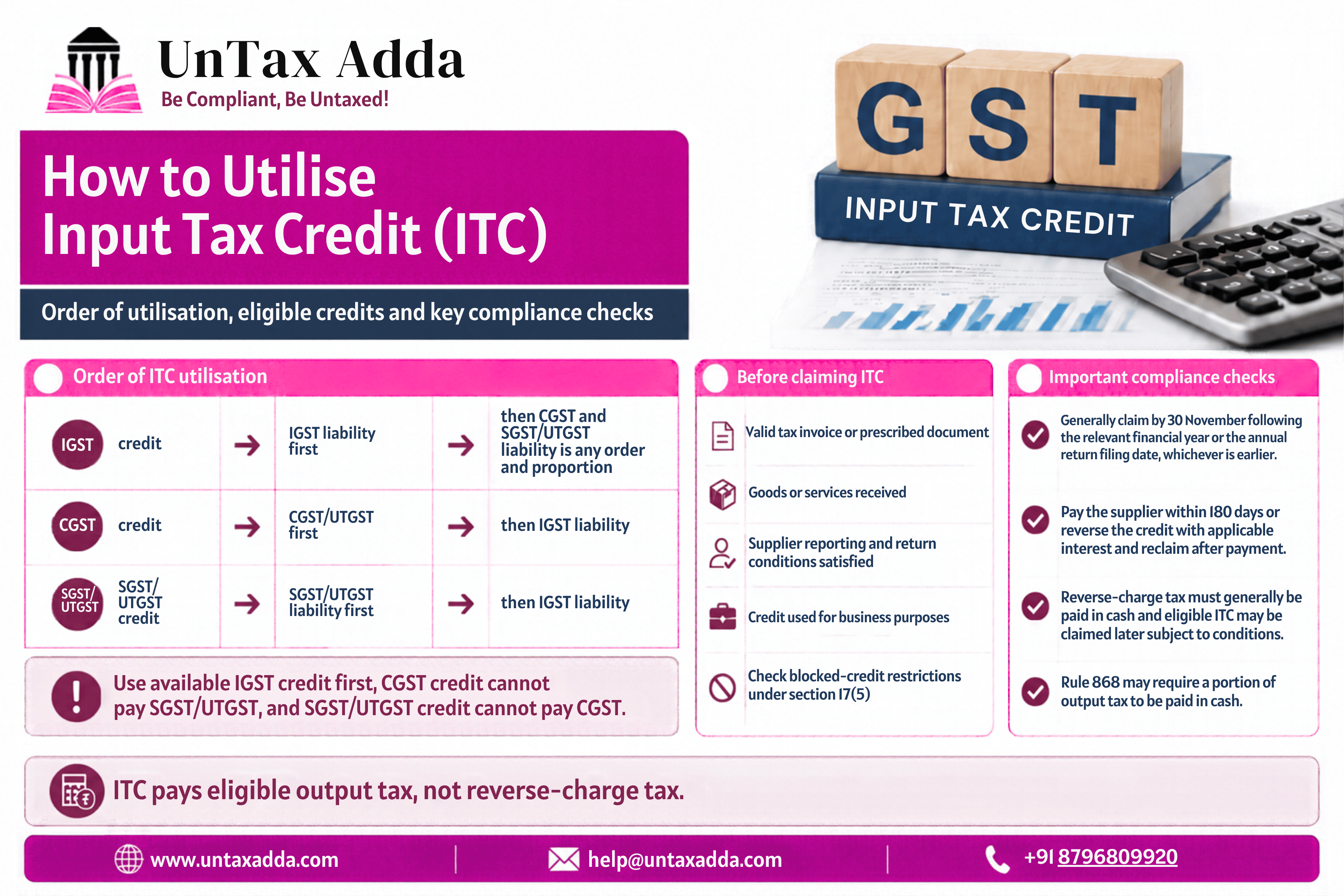
The GST framework enforces a strict hierarchy for setting off ITC against your output liability across different tax heads: IGST (Integrated GST), CGST (Central GST), and SGST/UTGST (State/Union Territory GST).
The Golden Rule
IGST Credit MUST be completely exhausted before you can use CGST or SGST credits.
Step-by-Step Offset Sequence
|
ITC Balance Available |
1st Priority (Set off against) |
2nd Priority (Set off against) |
3rd Priority (Set off against) |
|
IGST Credit |
IGST Output |
CGST Output |
SGST / UTGST Output (In any ratio/order) |
|
CGST Credit |
CGST Output |
IGST Output |
Cannot set off against SGST |
|
SGST / UTGST Credit |
SGST / UTGST Output |
IGST Output |
Cannot set off against CGST |
Key Cross-Setoff Restriction:
CGST credit can NEVER be used to pay SGST liability, and SGST credit can NEVER be used to pay CGST liability.
Items Ineligible for ITC (Blocked Credits under Section 17(5))
Not all business purchases qualify for Input Tax Credit. Under Section 17(5) of the CGST Act, credit is explicitly blocked for the following items:
a) Motor vehicles for transportation of persons (with seating capacity up to 13 persons), except when used for specific business purposes like driver training or further supply.
b) Food, beverages, outdoor catering, beauty treatment, and health services (unless required by law for employees).
c) Membership of clubs, health, and fitness centers.
d) Travel benefits extended to employees on vacation (e.g., leave or home travel concession).
e) Goods or services used for personal consumption.
f) Goods lost, stolen, destroyed, written off, or given as free samples or gifts.
g) Works contract services for the construction of immovable property (other than plant and machinery).
1. The Rule 86B Restriction (1% Cash Outflow Rule)
If your monthly taxable turnover (excluding exempt goods and exports) exceeds Rs. 50 Lakhs, Rule 86B of the CGST Rules restricts how much ITC you can use.
1) The Rule: You cannot use ITC to discharge more than 99% of your total output tax liability for that month. At least 1% of the total output tax liability must be paid in cash.
2) Key Exemptions to Rule 86B:
a) If the Managing Director, Proprietor, or Partners have paid more than ₹1 Lakh in Income Tax in each of the last two financial years.
b) If the registered person received a refund of unutilized ITC exceeding ₹1 Lakh in the preceding financial year on account of exports or an inverted duty structure.
c) If the entity is a Government Department, Public Sector Undertaking (PSU), or Local Authority.
2. Special Rules: Inverted Duty Structure & Capital Goods
A. Inverted Duty Structure
If the GST rate on your inputs/raw materials is higher than the GST rate on your outward supply/finished goods (e.g., input taxed at 18%, output sold at 5%), ITC will continuously accumulate in your electronic credit ledger.
- Solution: Under Section 54(3), you can claim a cash refund of the unutilized ITC accumulated due to the inverted tax structure.
- Note: Refund is allowable for ITC on input goods, but not on input services or capital goods.
B. ITC on Capital Goods (Machinery, Equipment, Computers)
When purchasing capital assets for business:
- No Double Dipping: You can either claim ITC on the GST portion OR claim depreciation under Income Tax on the GST amount. You cannot claim both.
- Depreciation vs. ITC Decision: Claiming ITC upfront usually yields a better cash flow benefit compared to spreading the tax tax-savings across several years via annual depreciation.
3. Handling Common ITC Complexities
A. Reverse Charge Mechanism (RCM)
Tax paid under RCM (e.g., payments for legal fees, GTA freight, director fees) cannot be offset using existing ITC balances in your Electronic Credit Ledger.
Crucial Distinction:
RCM liability must always be paid in CASH. However, once paid in cash, that amount becomes 100% eligible for ITC in the same or subsequent tax period (provided it is used for business purposes).
B. Common Credit Apportionment (Rule 42 & Rule 43)
If you manufacture or sell both taxable and exempt supplies, you cannot claim full ITC on inputs used for both:
1. Rule 42 (Inputs & Input Services): Requires monthly reversal of common ITC proportionate to the ratio of exempt turnover to total turnover.
2. Rule 43 (Capital Goods): The ITC on common capital assets is useful over a statutory life of 60 months (5 years). The reversal is calculated monthly based on the exempt portion of turnover.
4. Step-by-Step Action Plan for Financial Controllers
[Monthly Purchase Register] ──► [Match with Form GSTR-2B]
│
┌─────────────────────────────────┐
▼ ▼
[Matching Invoices] [Unmatched / Missing]
│ │
▼ ▼
Claim Eligible ITC in GSTR-3B Flag Vendor & Withhold Payment
│ until uploaded in GSTR-1
▼
Follow Strict Rule 88A Order:
(1) Exhaust IGST Credit First
(2) CGST ➔ CGST / IGST
(3) SGST ➔ SGST / IGST
Best Practices to Maximize and Safeguard Your ITC
1. Reconcile GSTR-2B with Purchase Books Monthly: Conduct regular monthly reconciliations between your purchase register and Form GSTR-2B to identify vendor mismatches early.
2. Vendor Compliance Management: Establish vendor management checks to ensure your suppliers file their GSTR-1 returns on time. Delayed filing by suppliers directly impacts your ability to claim ITC.
3. Track the 180-Day Payment Deadline: Maintain an aging schedule for supplier invoices to prevent reversal of ITC (and subsequent interest obligations) due to delayed payments.
4. Separate Ineligible Purchases: Classify personal expenses and blocked credits (under Section 17(5)) separately in your accounting software to avoid wrong ITC claims during return filing, which could attract penalties.
5. Annual Reconciliation (GSTR-9): Perform a full quarterly or annual true-up before the September/November tax return deadline following the end of the financial year to claim any inadvertently missed ITC
Need expert guidance on automated GSTR-2B reconciliations, handling GST audit notices, or managing complex ITC reversals? Contact our team at Untax Adda!